By 2028, carbon emissions from electricity generation in Scotland will look like a rounding error
22 May, 2026 - Gilbert West
We should get the latest breakdown of greenhouse gas emissions (GHG) next month. This new dataset will cover all sectors of Scotland’s economy in 2024. Electricity generation in Scotland is responsible for a tiny fraction of our GHG emissions. 2023’s figure dropped to 2.5% from 4% the previous year. 2024’s figure is likely to drop further and given the amazing year we’ve had so far, when the figures for 2026 are officially released (in 2028) electricity generation will probably be well under 1% of our emissions.
Let’s look at what we know so far this year. Records have been tumbling in Scotland and on the GB grids. 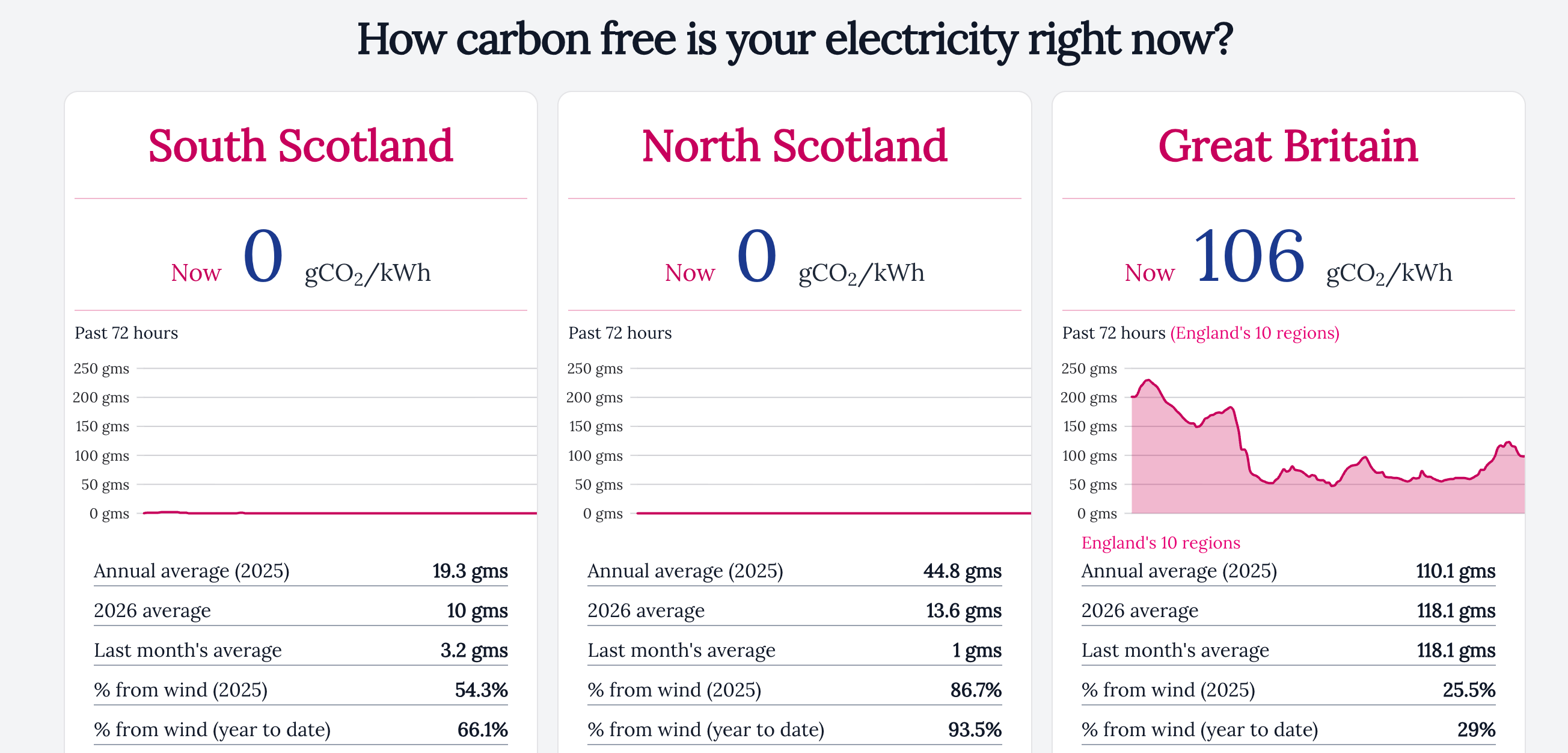
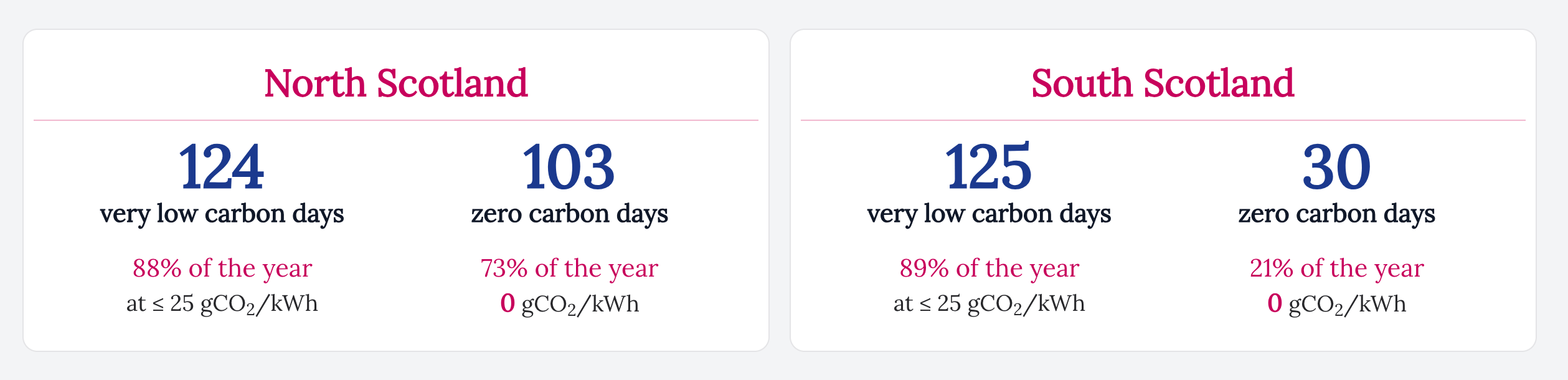
Today is day 142. Last weekend, North Scotland’s grid crossed 100 full days of zero carbon electricity. It now stands at 105 and another couple of full days will probably be added to the total by this weekend. That means Aberdeen, Dundee, Inverness and Perth have run on zero carbon electricity for 74% of the year so far. If we look at “very low” emissions i.e. < 25 gCO2/kWh we’re up to 89% of the time at zero to very low. (126 days).
South Scotland has shot ahead as well. They set a new record of 12 full zero carbon days last year, but already it has achieved 31 full zero carbon days (22% of the year) and 127 very low carbon days (89% of the year so far). This means Edinburgh, Glasgow, Stirling, most of Fife and everything south to the border is exceeding climate goals (on electricity) about 90% of the time.
So why am I so confident that we’ll have a consistently low-to-no carbon grid by 2028? A number of factors. We’ve achieved these great figures during a time when contributions from hydro and pumped storage have been very low and we know they will be significantly greater in the coming years after maintenance and new projects are online. We’ve also seen an extension to the generating life of Torness nuclear power plant which will stay online until 2030. It’s Scotland’s only remaining, functioning nuclear power plant, but nuclear still accounts for over 25% of South Scotland’s electricity. It has a capacity of about 1.2 GW peak: not something you want to lose overnight, but not a huge, irreplaceable capacity over 4 years.
So everything is sorted?
But while electricity generation may be careening towards a negligible part of the economy’s emissions, the pie still has to add up to 100%. As some sectors decarbonise, others don’t or at least, they don’t at a fast enough rate. Transport will probably emerge as the largest polluter again and at a higher proportion than previous years. Policy and profits drove the grid towards renewables. Fiscal incentives around transport have been lack lustre and not enough to support people to switch to EVs, public transport or active travel. £2 bus fare caps are great: if there’s a regular, reliable bus to catch. The majority in rural areas will remain car dependent for the foreseeable future and lower spending power makes switching to EVs difficult even though they are cheaper in the long run. High energy and fuel costs leech more and more disposable income from everyone, but often hit rural areas hardest. The volatility of war overseas is accelerating the switch, but only for those with the means to do so.
Talking of cutting unhealthy dependencies … this volatility has pushed decoupling electricity price from wholesale gas prices to the top of the meaningful political agenda. When something like this becomes embedded in everyday politics and conversations it’s a poison chalice for any politician that dares to ignore it. Meanwhile, Aldi, Wickes, Ikea and a plethora of online retailers stand in the aisles ready to help anyone with a few hundred quid in their pocket to take their first steps on the energy independence ladder. That’s more significant for Scotland than it might appear. Residential roofs are plastered with solar panels because there’s a direct benefit to the resident. So while a C&I developer may choose to site all of their developments in a location where they’ll get a 3% higher yield for their investment than some places in Scotland, these differences don’t matter a fig to Joe Homeowner.
Back to some good news
I mentioned at the beginning that this was a good year for grid GB, not just Scotland’s grids.
According to NESO the following records were broken this year:
- March 25 - Max wind hits 23.88 GW
- April 22 - Max zero carbon electricity on the grid 98.8%
- April 23 - Max solar hits 15.158 GW
Predictions for the end of 2026
We’re not even half way through the year, but I think that it’s very likely that North Scotland will achieve over 250 full zero carbon days, up from 2024’s record of 236 days. What really matters is the very low carbon days, but achieving zero more often than not does set a standard for others to follow.
As for South Scotland, I think it’s not inconceivable that it goes over 50 zero carbon days - over 4 times as many as last year - but again, it’s the very low carbon figures that count and I think that South Scotland will take the crown for lowest annual average carbon intensity. It was 19.3 grammes last year and it’s currently sitting at 10 grammes.